Slash Guest Complaints in 48 Hours (Without Spending a Cent)
A colleague runs a 26-room guesthouse on the Pelion coast. Last April, she had a 3.9 on Google, a 7.8 on Booking.com, and a shoebox full of printed complaint slips she called "the evidence drawer." Two months later - same rooms, same staff, zero renovation budget - she was at 4.3 and 8.4. The difference was not money. It was a 48-hour system she installed on a Tuesday and never removed.
This is that system. Five fixes, no spend, results within a weekend.
Fix 1: The 10-Minute Arrival Audit
Half of all complaints trace back to the first ten minutes. Not the mattress, not the breakfast, not the shower temperature. The arrival.
Behavioural psychology calls it anchoring: guests form their verdict almost immediately, and everything after is filtered through that first impression. A smooth arrival buys you three days of goodwill. A chaotic one puts every minor annoyance under a magnifying glass.
The Pelion guesthouse discovered that 60% of their negative reviews mentioned something that happened - or failed to happen - in the first hour. The Wi-Fi password was wrong on the card. The key stuck. No one was at reception. The room smelled like cleaning product.
The audit takes 10 minutes. Do it as if you are arriving as a guest for the first time:
For hotels:
- Walk from the car park or drop-off point to reception. Is the path obvious? Is the signage clear or are you guessing?
- Stand at the check-in desk for 60 seconds and observe. Is the greeting confident or rushed? Does the guest get the Wi-Fi code without asking?
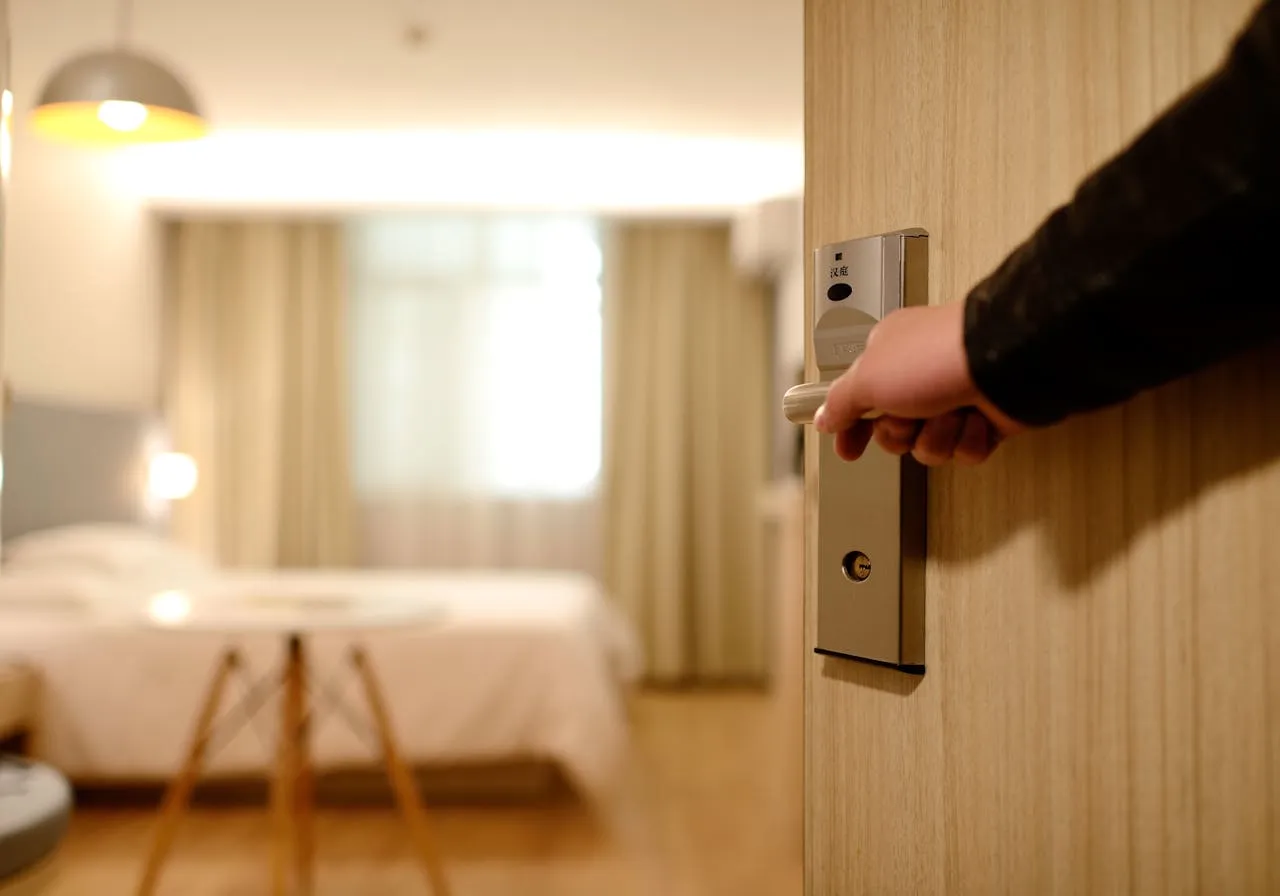
- Enter the room. What do you smell? Is it ready or does it look "just cleaned"? Are the lights on or are you fumbling for switches?
- Try the Wi-Fi on your phone. Does it connect in under 30 seconds?
For STR operators:
- Follow your own check-in instructions from the guest's perspective. If the PDF is longer than one screen, it is too long.
- Test the smart lock at 11pm with luggage in one hand. Does it work first try?
- Stand at the entrance. Is it lit well enough that a solo traveller feels safe?
- Open the door and take a breath. That first scent is the first review sentence.
The guesthouse owner did this audit on a Tuesday morning, fixed the stuck lock on Room 4, replaced every cleaning product with an unscented alternative, and printed a single A5 card with the Wi-Fi code, local taxi number, and check-out time. Arrival complaints dropped from eleven per month to three.
Fix 2: The Big 3 - Wi-Fi, Climate, Hot Water
If you read 500 one-star reviews across Booking.com and Google, three issues account for roughly 70% of them. Not decor. Not location. Not breakfast. The Big 3: Wi-Fi, climate control, and hot water.
Wi-Fi is now a utility, not an amenity. A 2025 Hotel Tech Report survey found that 35% of Gen Z guests rate Wi-Fi speed as more important than bed comfort. Siemlus reported that nearly one-third of negative hotel reviews in 2025 cited connectivity issues specifically. When the Wi-Fi does not work, nothing else matters - the guest cannot work, cannot stream, cannot message home.
Climate control failures are invisible until they are unbearable. A noisy AC unit at 2am is a one-star review waiting to happen. A thermostat that does not respond makes the guest feel powerless. The complaint is never "the AC was broken" - it is "I could not sleep and no one helped."
Hot water has a 90-second window. If hot water does not arrive within 90 seconds of turning the tap, the guest assumes it is broken. It does not matter if the boiler needs two minutes. Perception is the complaint trigger, not reality.
The zero-cost fix is a pre-arrival checklist:
| Check | Who | When | Takes |
|---|---|---|---|
| Wi-Fi speed test in every room (minimum 25 Mbps down) | Front desk or maintenance | Every Monday + before high-occupancy weekends | 2 min/room |
| AC unit test - cooling, heating, noise level, smell | Housekeeping at turnover | Every changeover | 1 min/room |
| Hot water flow test - must reach 38°C within 90 seconds | Housekeeping at turnover | Every changeover | 90 sec/room |
| Wi-Fi login test - QR code or simple password, connects first try | Front desk | Weekly | 5 min total |
The Pelion guesthouse found three dead Wi-Fi zones (a corridor, Room 12, and the breakfast terrace), one AC unit that rattled above 22°C, and a hot water delay in rooms 8 through 11 caused by pipe distance from the boiler. The Wi-Fi extender cost EUR 45. The AC fix was a loose screw. The hot water issue was solved by running the tap for 30 seconds before guest arrival - zero cost.
Big 3 complaints dropped from nine per month to two.
Fix 3: The Mid-Stay Message
Most complaints are born in silence. The guest notices a problem on day one, stews through day two, and publishes a review on day three. A single message on the first evening interrupts that cycle.
The message is simple:
"Hi [name], hope you're settling in well. If anything isn't perfect - temperature, Wi-Fi, anything at all - just reply here and we'll sort it before tomorrow morning."
That is it. No survey. No link. No marketing. Just a direct line with an implicit promise of speed.
Why this works: A 2025 study analysing 10,000+ hotel reviews through deep learning found that the majority of negative sentiment came not from major failures but from "micro-element" irritations - a missing towel, a strange smell, unclear instructions - that went unacknowledged. The guests who complained publicly were overwhelmingly the ones who never had a private channel to complain through first.
Properties using real-time guest messaging in 2025 reported up to 40% faster response times to issues and 8% higher satisfaction scores compared with reactive-only properties.
For hotels: Send via WhatsApp, SMS, or your PMS messaging tool. Timing matters - send between 6pm and 8pm on the first night, when guests have settled but before they have gone to dinner.
For STR operators: Automate it. Every major channel manager (Guesty, Hospitable, Lodgify) supports scheduled messages. Set it and forget it - but make sure replies go to a monitored channel, not a black hole.
The guesthouse owner sends the message manually via WhatsApp at 7pm. She estimates it takes four minutes per evening for all occupied rooms. About 30% of guests reply - mostly with "all good, thanks!" - but the 10% who flag an issue are the ones who would have become negative reviews. She fixes the problem that evening. The review never gets written.
Fix 4: The 3-Line Recovery Script
Things go wrong. That is not the problem. The problem is what your staff says when it happens.
Most complaint escalations are not caused by the issue itself - they are caused by the response. A guest with a broken AC who hears "let me check" and then waits 40 minutes in silence does not have an AC problem. They have a communication problem. And communication problems become reviews.
The 3A Script - Acknowledge, Apologise, Act:
1. Acknowledge: "Thank you for telling me - I completely understand how frustrating that is."
This is not performative. It signals that the guest has been heard. Tension drops immediately.
2. Apologise: "I'm sorry this happened."
One sentence. Direct. Not defensive. Not "I'm sorry you feel that way" - that is a non-apology and guests recognise it instantly.
3. Act: "Here's what I'm doing: [specific action] in [specific timeframe]. I'll come back personally to confirm it's fixed."
The specificity is everything. "Someone will look at it" is not a recovery. "Our engineer will be there in 15 minutes and I will check back with you at 3pm" is a recovery.
Train this in 10 minutes, not 10 hours. Role-play three scenarios: a guest whose room is not ready, a guest whose AC is not working, and a guest who heard noise at 2am. Have each staff member deliver the 3A script until it sounds natural. Then do it once per week at shift handover.
A 2024 deep learning analysis of online reviews confirmed that guests are significantly more forgiving of service failures when recovery is immediate and personal - even when the fix itself is minor. The driver of negative reviews is not the problem. It is indifference.
The guesthouse trained three staff members in one morning. The owner reports that the single biggest change was not the script itself but the confidence it gave her team. Before, they froze or over-apologised. Now they have a protocol. Guests notice the difference.
Fix 5: Close the Loop Before Checkout
The last hour of the stay is where unresolved frustrations either dissolve or crystallise into reviews. Most negative reviews are submitted within four hours of checkout - often at the airport, on the transfer bus, or in the taxi. The window to intervene is smaller than you think.
Send a pre-checkout message on the morning of departure:
"Good morning! Before you head out - is there anything we can still improve for you? We'd rather fix it now than read about it later."
That last line is deliberately honest. It works because it acknowledges what guests are already thinking. They are going to review you. You are asking them to give you one last chance to earn a better one.
If a guest raises an issue at checkout:
- Fix it immediately if possible - even a gesture matters (a coffee, a late checkout by 30 minutes, help with their bags)
- Never minimise: "Oh, that's unusual" dismisses their experience. "I'm sorry - that shouldn't have happened and I'll make sure it doesn't again" validates it
- Close with a human line: "I'm glad we could sort that. Safe travels."
If you cannot fix it before they leave, follow up within 24 hours:
"Thank you for letting us know about [specific issue]. We've now [specific action taken]. We hope to welcome you back."
This follow-up converts a potential one-star review into a "had an issue but they handled it well" three or four-star review. That shift in one sentence is worth more than most marketing budgets.
The 48-Hour Implementation
Here is the exact sequence the guesthouse followed:
Tuesday morning (2 hours):
- Walk the arrival audit for every room type
- Fix immediate issues (signage, Wi-Fi codes, door locks, scents)
- Run Big 3 checklist on all occupied rooms
- Print the pre-arrival maintenance checklist for housekeeping
Tuesday afternoon (1 hour):
- Set up mid-stay WhatsApp message template
- Train staff on the 3A script (three role-play scenarios)
- Draft the pre-checkout message template
Wednesday morning (30 minutes):
- Send first mid-stay messages to current guests
- Brief housekeeping on the Big 3 checklist at turnover
- Pin the 3A script behind the front desk
Thursday onward: the system runs itself. The arrival audit becomes a monthly habit. The Big 3 checklist is part of every changeover. The messages are automated or take four minutes per evening. The script is muscle memory within a week.
The guesthouse results after 60 days:
- Negative reviews per month: 14 to 6 (57% reduction)
- Google rating: 3.9 to 4.3
- Booking.com rating: 7.8 to 8.4
- Complaint slips in the evidence drawer: the drawer is now used for menus
None of this required a renovation. None of it required new staff. None of it required budget approval. It required a Tuesday, a WhatsApp account, and the willingness to ask guests what was wrong before they told the internet.
Most complaints are not storms. They are drips. Fix the drips and the storms never come.