The 30-Second Rule That Turns First-Time Guests Into Loyal Customers
A guest walks through your lobby door. They have been travelling for hours. They are tired, possibly disoriented, and carrying the low-grade anxiety that comes with arriving somewhere unfamiliar. In the next thirty seconds, their brain will make a series of rapid judgments about your property, your staff, and whether they made the right booking decision. Those judgments will color every interaction for the rest of their stay.
This is not motivational speaking. It is neuroscience. And the hotels that understand it are winning a loyalty game that no points program can match.
The Science Behind Snap Judgments
In 1992, psychologists Nalini Ambady and Robert Rosenthal published a landmark study at Harvard on what they called "thin slicing," the human ability to form accurate impressions from extremely brief exposures. Their research, published in the Psychological Bulletin, demonstrated that people watching just 30 seconds of a teacher's nonverbal behavior could predict end-of-semester student evaluations with striking accuracy. The judgments formed in half a minute were nearly as reliable as those formed over an entire semester.
This principle extends well beyond classrooms. Princeton psychologist Alexander Todorov later showed that people form trustworthiness judgments in as little as 100 milliseconds, about the time it takes to blink. His 2006 research, published in Psychological Science, found that these snap impressions were remarkably stable: giving people more time to evaluate rarely changed their initial assessment. It only increased their confidence in it.
For hospitality, the implication is stark. Your guest is not consciously evaluating your lobby decor or your receptionist's uniform. Their brain is running a rapid, largely unconscious assessment: Am I safe? Am I welcome? Did I make a good choice? And that assessment crystallizes within the first 30 seconds of the arrival experience.
Cornell University's Center for Hospitality Research confirmed the operational relevance in a 2018 study finding that 70% of online hotel reviews reference the arrival experience, either positively or negatively. The arrival is not just one moment among many. It is the moment that anchors the guest's entire narrative about their stay.
What Happens in Those 30 Seconds
The 30-second rule is not a single action. It is a sequence of micro-moments that either build confidence or erode it.
Seconds 1 to 5: Environmental Scan
Before a word is spoken, the guest reads the physical space. Is the entrance clean and well-lit? Is there a clear path to the front desk? Does the space feel organized or chaotic? Research from the Journal of Environmental Psychology shows that people form environmental assessments in under five seconds, and those assessments directly influence their expectations of service quality.
For STR operators, this moment happens at the property entrance. A well-lit doorway, a clear house number, and an entry that does not require hunting for a hidden lockbox sets the tone before the guest steps inside.
Seconds 5 to 15: Human Recognition
This is the critical window for acknowledgment. The guest needs to feel seen. Not necessarily greeted with a full welcome speech, but recognized. Eye contact, a nod, a brief "Welcome, I'll be right with you" from a staff member who is currently helping another guest. Anything that signals awareness.
A 2019 study by J.D. Power on hotel guest satisfaction found that properties where guests reported being acknowledged within 10 seconds of entering the lobby scored 65 points higher on their satisfaction index than properties where guests had to wait or seek attention. Sixty-five points on a 1,000-point scale is the difference between a hotel that earns repeat business and one that survives on OTA discounting.
Seconds 15 to 30: Orientation and Competence
By this point, the guest should feel oriented. They know where to go, who is helping them, and that the process will be efficient. This is where the check-in experience, whether traditional, kiosk-based, or mobile, either confirms or undermines the positive impression built in the first 15 seconds.
The key here is not speed for its own sake. It is the absence of confusion. A guest who waits 90 seconds in a well-organized queue while a staff member makes eye contact and smiles will feel better than a guest who is processed in 30 seconds by someone who never looks up from the screen.
How the Best Hotels Train for 30 Seconds
The properties that consistently win on first impressions do not leave them to chance. They engineer the arrival experience with the same rigor they apply to revenue management or food safety.
The Ritz-Carlton: The Three Steps of Service
The Ritz-Carlton's legendary service culture is built on what they call the Three Steps of Service: a warm and sincere greeting using the guest's name when possible, anticipation and fulfillment of each guest's needs, and a fond farewell again using the guest's name. This framework has been part of their Gold Standards since the company's founding, and every employee, from doorman to general manager, rehearses it daily during the company's famous "lineup" meetings.
Former Ritz-Carlton president Horst Schulze has written extensively about how these first moments are non-negotiable. In his book "Excellence Wins," Schulze describes how properties that mastered the arrival greeting saw measurable lifts in guest satisfaction scores and, crucially, in repeat booking rates. The Ritz-Carlton consistently ranks among the top luxury brands for guest loyalty, and Schulze attributes a significant portion of that to the discipline of the first interaction.
Four Seasons: Anticipatory Recognition
Four Seasons takes a different but equally systematic approach. Their front-of-house teams are trained in what the company calls "anticipatory service," which at the arrival stage means recognizing returning guests before they reach the desk. Staff review arrival lists daily, study guest preference profiles, and in many properties, a manager or senior staff member greets repeat guests by name at the entrance.
Isadore Sharp, the Four Seasons founder, described this philosophy in his memoir "Four Seasons: The Story of a Business Philosophy." The key insight is that recognition is more powerful than any amenity. A guest who hears their name at the door feels a fundamentally different emotional response than one who is asked to spell it at the desk.
Four Seasons properties that implemented enhanced arrival recognition protocols reported a 15% increase in repeat direct bookings over a two-year period, according to internal data shared at the 2023 ALIS (Americas Lodging Investment Summit) conference.
citizenM: Designing Out the Friction
Not every property competes on white-glove service. citizenM, the Dutch hospitality brand, took the opposite approach by engineering the arrival experience to require almost zero human interaction. Guests check in at self-service kiosks, collect their room key card, and proceed directly to their room. The lobby is designed as a social space, not a processing center.
The result is that citizenM eliminated the single biggest source of negative arrival impressions: the check-in queue. Their guest satisfaction scores on arrival experience consistently rank above 90%, and the brand has expanded to over 30 properties globally with a model built entirely on the principle that frictionless equals positive.
The STR Operator's 30-Second Challenge
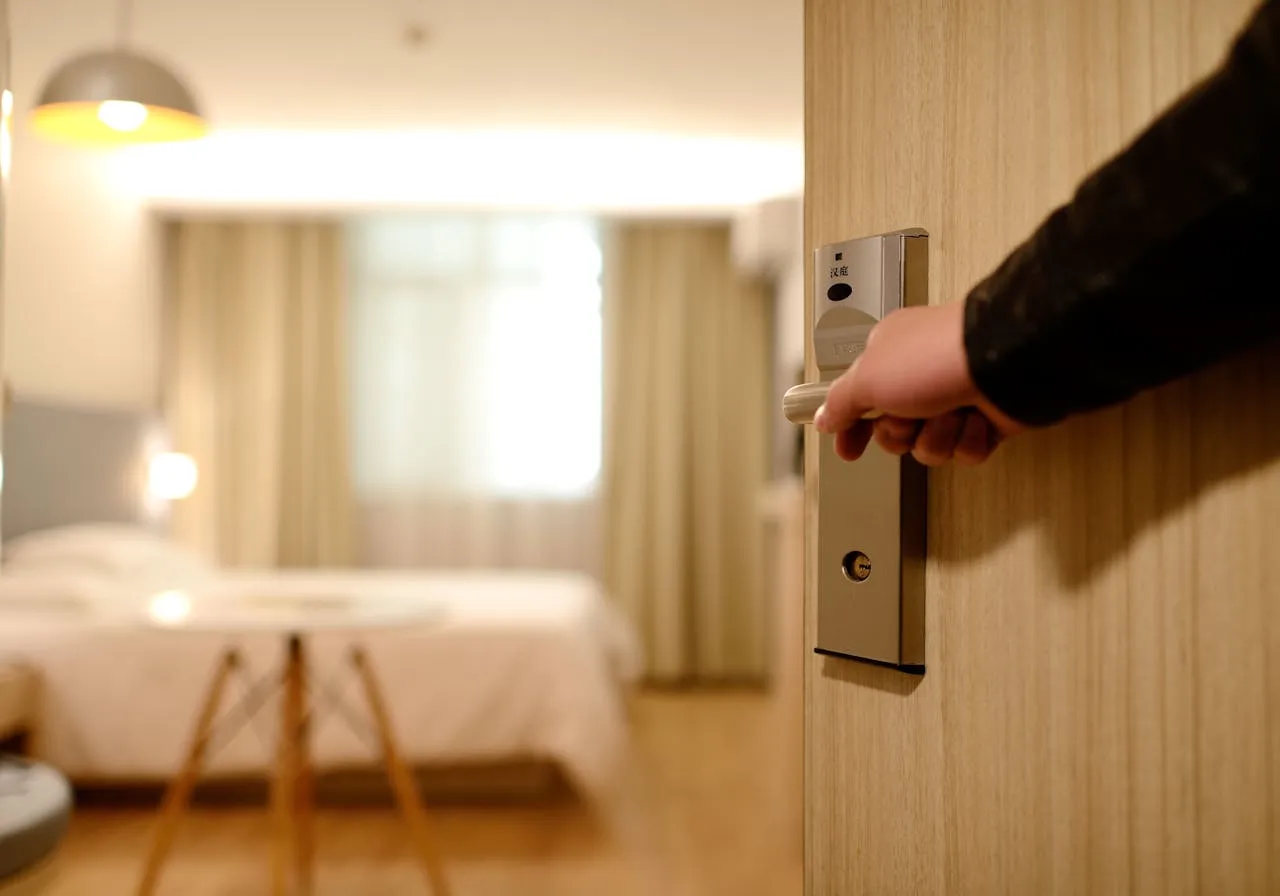
Short-term rental operators face a fundamentally different version of this challenge. There is usually no human present at arrival. The guest's first 30 seconds are spent interacting with a door, a lockbox, or a smart lock, followed by their first impression of the space itself.
This makes the pre-arrival communication and the physical entry experience even more critical. The best STR operators treat the entry sequence like a product design problem.
Matt Landau, founder of the VRMB community (Vacation Rental Marketing Blog) and one of the most respected voices in the STR space, has documented how top-performing rental operators obsess over what he calls the "threshold moment." His research across hundreds of high-review-score properties identified three consistent elements: arrival instructions that are impossible to misunderstand (with photos of the exact door and lock), an entry experience that feels welcoming (lighting, cleanliness, a small personal touch visible within the first five seconds), and a follow-up message sent 15 minutes after the scheduled check-in time asking if everything is perfect.
Operators who implemented Landau's threshold framework reported an average increase of 0.3 stars in overall review scores across platforms, a meaningful lift in an ecosystem where the difference between 4.7 and 4.9 stars can mean a 20% difference in booking volume.
Evolve, the STR management platform operating across 24,000-plus properties, conducted an internal analysis in 2023 that found the single strongest predictor of a five-star review was not the property's amenities or location. It was whether the guest experienced any friction during check-in. Properties with seamless digital check-in scored 34% higher on overall guest satisfaction than those where guests reported any difficulty accessing the property.
Measuring the Impact: First Impressions and the Bottom Line
The financial case for mastering the first 30 seconds is not theoretical. Multiple data points connect arrival experience quality to revenue outcomes.
ReviewPro, the guest intelligence platform used by over 65,000 hotels globally, published a 2023 analysis showing that properties with arrival-experience satisfaction scores in the top quartile achieved ADR premiums of 8 to 12% compared to properties in the bottom quartile within the same market segment. Guests who feel good about arrival are more tolerant of premium pricing and more likely to book direct on return visits.
Bain and Company's frequently cited research on customer retention shows that a 5% increase in retention rates produces profit increases of 25 to 95%, depending on the industry. In hospitality, where acquisition costs through OTAs run 15 to 25% of booking value, shifting even a fraction of first-time guests to repeat direct bookers produces outsized returns.
TripAdvisor's own data analysis, published in their 2024 Hospitality Trends report, found that guests are 3.9 times more likely to choose a hotel with higher review scores over a lower-scored competitor. Since arrival experience is mentioned in 70% of reviews, improving those first 30 seconds has a direct and measurable impact on competitive positioning.
Building a Repeatable System
The trap most operators fall into is relying on individual personality rather than systematic execution. A naturally warm receptionist delivers a great arrival experience on Monday. Their less outgoing colleague works Tuesday, and the guest experience drops. Consistency, not occasional brilliance, is what drives loyalty.
For Hotels: The Arrival Playbook
Build a documented arrival sequence that every front-of-house team member rehearses. Not a script to recite, but a framework with clear checkpoints.
Checkpoint 1 (0 to 5 seconds): Visual acknowledgment. Eye contact and a nod or smile the moment the guest enters the lobby. If staff are occupied, a verbal acknowledgment: "Welcome, I will be with you in just a moment."
Checkpoint 2 (5 to 15 seconds): Verbal greeting using the guest's name if available from the arrivals list. A brief orientation statement: "Your room is ready" or "Let me get you checked in quickly."
Checkpoint 3 (15 to 30 seconds): Efficient handoff to the check-in process, whether traditional, kiosk, or mobile. The guest should feel that the process is moving and that someone competent is in control.
Train this weekly. Role-play it during pre-shift meetings. Measure it by mystery-shopping your own property monthly.
For STR Operators: The Arrival Sequence
48 hours before arrival: Send clear, photo-illustrated check-in instructions. Include a photo of the exact entrance and lock. Confirm the door code works.
2 hours before arrival: Send a brief welcome message with one local recommendation (a nearby restaurant or coffee shop) and a reminder of the check-in process.
15 minutes after scheduled arrival: Send a proactive check-in message: "Just making sure everything looks perfect. Let me know if you need anything."
Inside the property: A clean, well-lit entrance with one visible personal touch: a handwritten note, a local snack, or a small bouquet. The guest's first visual impression inside should communicate care.
Actionable Takeaways
Audit your current arrival experience. Have someone unfamiliar with your property arrive as a guest and document their first 30 seconds. What they report will likely surprise you.
Train for acknowledgment speed, not check-in speed. Guests forgive a 2-minute check-in if they were acknowledged within 5 seconds. They do not forgive being invisible for 30 seconds even if check-in takes 60.
Systematize, do not improvise. Write down your arrival framework. Rehearse it. Hold staff accountable to it. Personality is a bonus, not a strategy.
Measure arrival satisfaction separately. Do not bury it in an overall satisfaction score. Ask specifically about the arrival experience in post-stay surveys and track the trend weekly.
Read your reviews through the arrival lens. Search your reviews for words like "welcome," "check-in," "arrival," and "first impression." You will quickly see whether your 30-second execution is working or failing.
The 30-second rule is not a hospitality platitude. It is a measurable, trainable, systematizable competitive advantage. The properties that master it do not just earn better reviews. They build the kind of instinctive guest trust that no loyalty program, no discount, and no marketing campaign can replicate.